

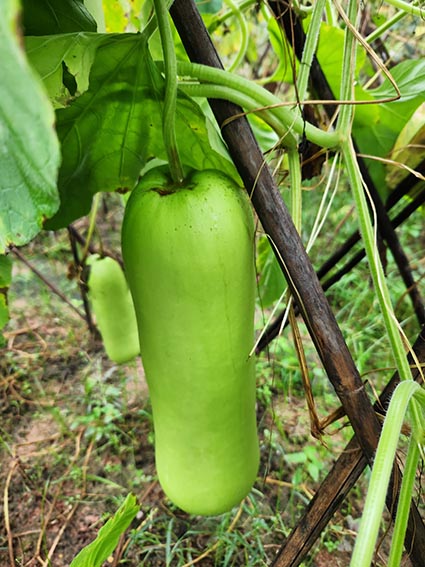
Long green bottle gourd
Description of the variety
Scientifically known as Lagenaria siceraria, the long green bottle gourd is a vigorous vine that produces cylindrical to slightly curved fruits with pale green skin and white flesh. The plant has soft, hairy stems and large, heart-shaped leaves, and climbs using tendrils. It bears white, night-blooming flowers, with male and female flowers appearing separately on the same plant. Native to tropical Asia and Africa, it thrives in warm, humid climates and is widely cultivated across southern China and Southeast Asia.
Planting Guidelines
Sow seeds directly into well-drained, fertile soil once the danger of frost has passed and daytime temperatures consistently exceed 18°C. Choose a sunny location and provide sturdy trellises or supports for the vines to climb. Plant seeds 2–3 cm deep, spacing them 60–90 cm apart. Keep the soil moist but not waterlogged, and apply compost or organic fertilizer during early growth. Bottle gourds are shallow-rooted but spread widely, so mulching helps retain moisture and suppress weeds. Regular watering and occasional feeding with balanced fertilizer will support healthy fruit development.
Additional Remarks
Long green bottle gourd is relatively pest-resistant but may attract aphids, fruit flies, or powdery mildew in humid conditions. Early harvesting ensures tender texture and better flavor, while overripe fruits may become fibrous. Training the vines vertically improves air circulation and fruit shape.
Diseases Information
Planting Timetable
| MONTH | JAN | FEB | MAR | APR | MAY | JUN | JUL | AUG | SEP | OCT | NOV | DEC |
| SOWING | ||||||||||||
| TRANSPLANTING | ||||||||||||
| HARVEST |
The above schedule is based on the Sydney lowland area